
What Is ABM Marketing (And Why AI Changes Everything)
That's changing fast. AI hasn't just made ABM marketing easier. It's rewritten what's possible. Nearly half of B2B marketers (49.2%) now report that ABM is the highest source of ROI in their organization, and with AI in the mix, that number is only going to climb.
Teams that used to spend weeks identifying target accounts, months building personalized campaigns, and entire sprints hand-crafting individual landing pages can now do all of that in a fraction of the time, with more precision and better results.
ABM marketing is a B2B strategy where sales and marketing teams put their resources behind a defined set of high-value target accounts instead of generating leads in volume and hoping the right ones convert. Instead of casting a wide net, you cast a very precise one.
The traditional objection to ABM was always resources. True personalization at the account level (custom messaging, tailored content, one-to-one outreach) doesn't hold up when humans are doing it manually. That's why so many ABM programs ended up as "ABM in name only": account lists with slightly segmented email sequences and a personalized logo dropped onto a generic landing page.
AI eliminates that bottleneck. And the momentum is real: 86.2% of respondents expect AI to boost ABM ROI even further over the next year.
Step One: Let AI Tell You Who to Target
The foundation of any ABM campaign is account selection. Get this wrong and everything downstream (your content, your campaigns, your landing pages) is wasted on the wrong audience.
Historically, this was a manual process. Sales leadership built account lists based on ICP criteria, gut feel, and CRM data that was often weeks out of date. AI flips this entirely. Modern intent data platforms process millions of behavioral signals (website visits, content consumption, search activity, technology installs, hiring patterns) to surface accounts that are actively in-market right now.
75% of ABM leaders now use AI tools to optimize campaign performance, personalize outreach, and predict account intent. Martal Group implemented an AI-driven platform to sharpen their targeting and act on intent signals, which contributed to 762% revenue growth and a meaningfully more efficient outreach process.
Stop building account lists from static spreadsheets. AI-powered intent tools give your team a live, continuously updated view of which accounts are raising their hand, even before they fill out a form or talk to sales. That's the window you want to be in.
70% of the buyer's journey is completed before contacting sales. If you're waiting for an inbound signal to engage a target account, you've already missed most of it.
Running ABM Campaigns That Actually Work
Account identification is just the starting point. The real differentiation in ABM marketing comes from how you run your campaigns. This is where most teams either level up or stall out.
ABM campaigns typically operate at three tiers: one-to-one (dedicated campaigns for individual high-value accounts), one-to-few (campaigns targeting a cluster of similar accounts), and one-to-many (broader campaigns across a larger defined audience). AI has transformed what's achievable at each tier, but the biggest gains are at the one-to-one and one-to-few levels where personalization used to hit a hard ceiling.
The most effective ABM teams run on first-party data, behavioral insights, and real-time optimization. Each engagement is informed by live intent signals, continuously refined as more data comes in. Less "we sent the right message to the right list" and more "we knew exactly what to say because we watched the account tell us."
In practice, this looks like:
LinkedIn: Still the dominant channel for B2B ABM campaigns. The best teams go well beyond standard audience targeting. One team built a compounding personalization engine using AI-assisted workflows to dynamically tailor ad creative and landing pages per account, including the target company's logo and name in the ad itself. Simple change. Significant impact on CTR.
Email: The best ABM email campaigns include references to specific challenges faced by the account based on intent data, personalized video messages from sales reps, tailored case studies from similar industries, and direct references to recent company news. Generic sequences don't cut it anymore.
Events and direct mail: Both are having a quiet comeback in ABM. Account-specific event invitations and triggered direct mail (sent when a target account hits a specific behavioral threshold) are proving to be high-signal, low-noise touches that cut through digital saturation.
The most important principle across all of it: AI can help you scale personalization, but it can't fix bad strategy. A personalized LinkedIn ad followed by a generic BDR email kills trust faster than bad creative. Coherence across your ABM campaigns is not optional.
ABM Landing Pages: The Conversion Layer Most Teams Get Wrong
Here's where ABM marketing most consistently breaks down. A team builds a smart account list, runs thoughtful ABM campaigns with personalized creative, and then sends every prospect to the same generic website.
The ABM landing page is where intent meets experience. It's the moment a prospect clicks your ad and decides in four seconds whether you actually understand their business or whether you're just another vendor with their logo swapped in.
An ABM landing page is a highly personalized web page designed for a specific company or a small group of target accounts, using tailored messaging, imagery, and offers to address the unique needs and pain points of that audience. The operative word is tailored. Not "we mentioned their industry." Tailored: their specific pain points, their competitive context, proof from companies like theirs, CTAs built around their use case.
A generic CTA asks a visitor to "Learn More." A strong ABM landing page offers a demo built around their specific use case or a case study from a company just like theirs. That's the difference between a bounce and a booked meeting.
The five elements that make an ABM landing page actually convert:
1. A personalized headline speaks to the account's problem, not your product's features
2. Account-specific social proof uses case studies or logos from their industry, their company size, their region
3. Dynamic content blocks adapt messaging and product emphasis based on firmographic signals or known account data. Use first-party data to surface the parts of your product most relevant to that persona. A security-focused buyer should see something different than a RevOps leader, even if they're at the same target account.
4. A tailored CTA goes beyond "Request a Demo" to something like "See How [Company] Can [Specific Outcome]"
5. Message match means the page mirrors what the ad promised, exactly
If your ad led with "Cut time-to-close for enterprise sales teams" and your landing page opens with your product positioning statement, you've broken the thread.
The scale challenge is real. Building this level of personalization for five accounts is manageable. Building it for fifty (or five hundred) is where most teams hit a wall and either cut corners or abandon the approach entirely.
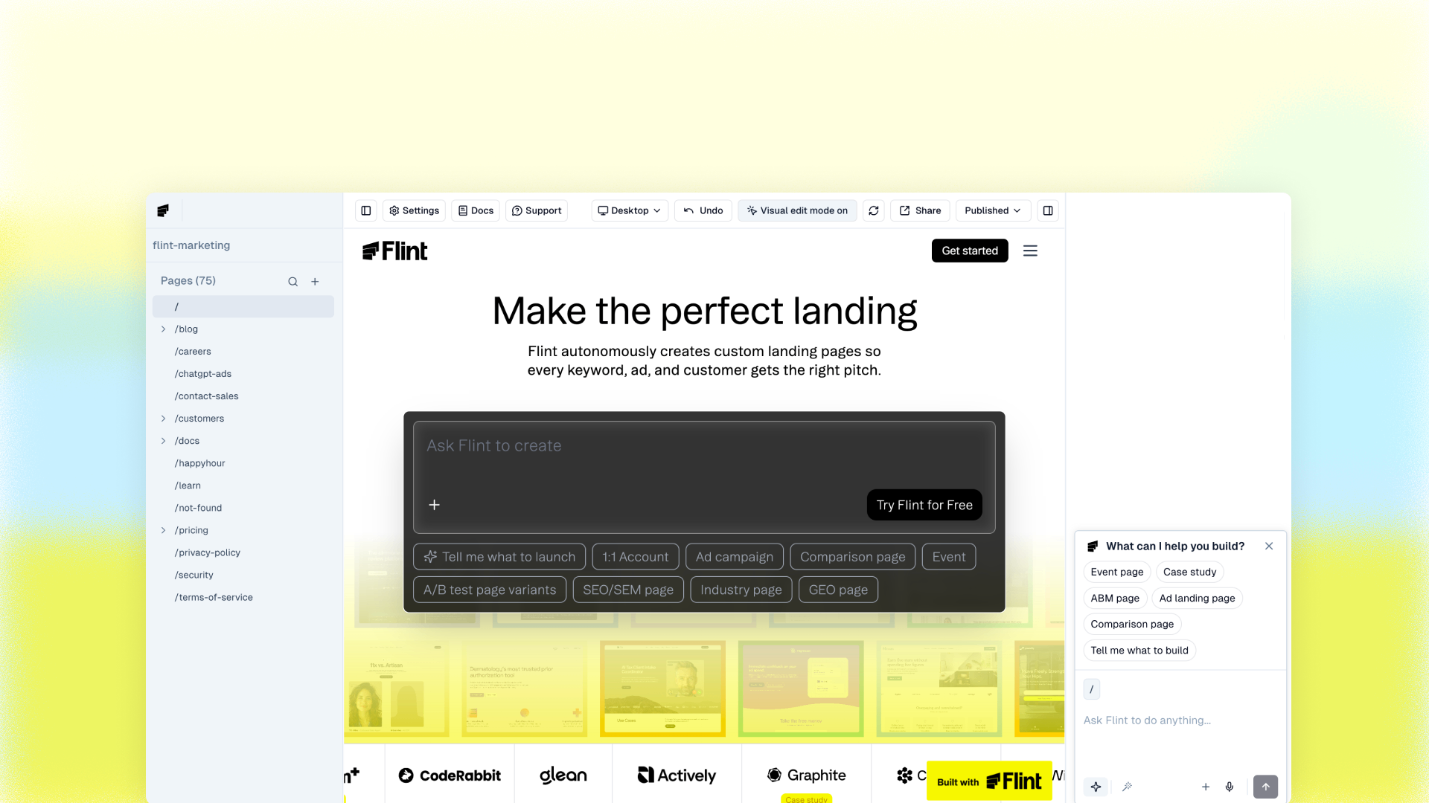
That's exactly the problem Flint was built to solve. Flint is an autonomous web platform that generates on-brand, conversion-ready ABM landing pages directly from the account data your team already has. Feed it a Salesforce export, an AE brief, a Clay enrichment, even an S-1 filing, and Flint builds a pixel-perfect, fully personalized page that lives on your domain. Not a template with variables swapped in. A page that looks like your design team made it, because Flint imports your full brand system from your existing site. Customers launch their first ABM page within 30 minutes. When one detail changes, Flint syncs it across every page automatically.
Your team spends its time on strategy, not production. And every target account gets a landing page that actually speaks to them. Try Flint for free at tryflint.com
From ABM Campaigns to Account-Based Experience
ABM marketing doesn't stop at campaigns and landing pages. The next step is Account-Based Experience (ABX), where personalization extends across the entire customer lifecycle, not just acquisition. Sales, marketing, and customer success all work around the same high-value accounts to drive engagement, retention, and expansion, with AI handling the coordination that used to require a small army.
Looking ahead, AI will power always-on, predictive ABM, going beyond content generation to inform real-time decisions. Predictive account scoring, AI co-pilots for sales, website experiences that adapt the moment a target account lands on your page. The teams that get there fastest will be the ones who built their strategy around data first and kept a human eye on the output.
Start Here
If you're looking to modernize your ABM marketing approach, the priority order is straightforward:
First, audit your account selection process. If you're building lists manually without intent data, you're targeting on guesswork. Identify an AI-powered intent signal source and run a pilot.
Second, tighten message coherence across your ABM campaigns. Run your current ad creative, email sequences, and landing pages side by side and ask whether they tell one clear, account-specific story. Most teams will find significant gaps.
Third, fix your ABM landing pages. If you're running account-based campaigns but sending traffic to generic pages, you're leaving the most important conversion moment on the table.
That last step is where Flint comes in. Try Flint for free at tryflint.com, or if you have a more complex setup you'd like to walk through with our team, contact us.
ABM marketing has always been the smarter play. AI just made it possible for every team to run it the right way.